10. Big Swings. In January, The New York Times interviewed John Krasinski about the success of A Quiet Place. It felt like a victory lap for Krasinksi: Dunder Mifflin’s ninth-biggest salesman turned action movie star and critically-acclaimed director. Midway through the interview, they prompted him with a non-question: “Paul Thomas Anderson hosted an award screening for your film. That’s got to be gratifying.”
Krasinksi: “I think I’ve only told my wife this, so why not say it in an interview: That was the moment that was the most surreal of all this. He emailed me and said, ‘you need to call me,’ and we talked on the phone and he was so specific and so honest about the movie. He’s been so kind to me through my career, but we were talking like we were on an even playing field, and that tripped my wires. What I love most about Paul is that he loves movies.”
He kept gushing about PT Anderson—his mentorship, his inclusiveness, his warmth.
“I’ll tell you a big life lesson. Paul was over at my house, I think it was my 30th birthday party, and I had just seen a movie I didn’t love. I said to him over a drink, ‘It’s not a good movie,’ and he so sweetly took me aside and said very quietly, ‘Don’t say that. Don’t say that it’s not a good movie. If it wasn’t for you, that’s fine, but in our business, we’ve all got to support each other.’ The movie was very artsy, and he said, ‘You’ve got to support the big swing. If you put it out there that the movie’s not good, they won’t let us make more movies like that.'”
It’s a beautiful, refreshing sentiment: that even “if it wasn’t for you, that’s fine.” To take big swings. And to support big swings.
9. Maya Eriskne’s performance on Pen15. The show is so raunchy, unsettling, often surreal, and definitely something you don’t watch with mom—like a funnier 8th Grade or like Big Mouth’s live-action spiritual cousin. But Erskine’s performance is so huge-hearted and deranged and vulnerable and hilarious. Watching her (and her bowl cut) decide on an AOL screen name is maybe the hardest I’ve laughed at anything in 2019. It’s not that her co-star, Anna Konkle, isn’t also a FORCE in portraying pubescent awkwardness; they’re both all-stars on the same team, but Erskine is MVP Mookie Betts to Konkle’s Andrew Benintendi.
8. Notting Hill. How I’d never seen this before is beyond me. It has everything I need in a movie: a rom-com that manages to be both truly romantic and truly funny; an ensemble cast that never feels bloated, where every peripheral character has a funny niche (the sister! the roommate!); a soundtrack that includes Al Green, Bill Withers, and Shania Twain (!). There’s Hugh Grant before he became smarmy Hugh Grant. There’s Julia Roberts in her most autobiographical and maybe most endearing role.
And, more than anything, on center stage is my actual, personal, romantic fantasy: awkward dweeb, in book store, sees gorgeous, famous actress/singer. Then acts awkwardly. Then happily ever after (expect, in my fantasy, it’s Norah Jones or Selena Gomez or Eva Mendes or Charlize Theron or #2 on this list…)
7. Mike Posner. I used to LOATHE Mike Posner. For years, he was the misogynistic frat dude from Duke who produced for Justin Bieber and sang about the yucky things you’d expect a misogynistic frat dude from Duke to sing about. This past Thanksgiving, I was watching the halftime show of the Lions/Bears game, and there was this shaggy, bearded guy singing a sad song—like a Millennial Cat Stevens dressed up as Bob Ross, I thought. But no! Alas! It was Mike Posner! Who has clearly undergone a whole-being, spiritual transformation. And has clearly grown into the sturdy, resilient, compassionate, curious sensei he is. (It reminds me of another guy who had some shit-head arrogance in his late teens, early 20s. Who’s had some random, big exposure for things he’s made and has realized how he’s more comfortable namastay-ing out of the spotlight).
The whole interview’s a treat (as is his website), but 1:11:10 to 1:13:19 is especially a treat:
6. Knock Down The House. Five things in movies that will always make me cry: Sad Circumstances For Little Kid (eg. Bicycle Thieves, The Lion King, Beasts of the Southern Wild), Someone Says Goodbye (Toy Story 3, Inside Out, E.T.), Gentle Soul Lifts Someone/Reminds Them Of Their Worth And/Or That It’s Not Their Fault (Won’t You Be My Neighbor?, Good Will Hunting, Moonlight), Unlikely Friendship Blossoms And/Or Broken Friendship Mends (Remember The Titans, Moneyball—the final scene. Duh.), Selfless Person Fights For The Well-Being Of Others (Roma, RBG).
Knock Down The House checks off three maybe four of these. My eyes were not dry— the three times I watched the trailer and the one time I watched the movie on Netflix. It felt like both a rallying cry and a big hug. (I’m not tech-savvy and am trying to figure out how to turn AOC’s self-affirming, private pep-talks into my phone’s alarm clock.)
5. “Priestdaddy”—Patricia Lockwood. Not hyperbole: this is maybe—probably—the funniest book I’ve ever read. It’s also heartbreaking and reminded me of Vonnegut’s line that “laughter and tears are both responses to frustration and exhaustion. I myself prefer to laugh since there is less cleaning up to do afterward.” It’s about Lockwood as a young, irreverent poet coming to terms with her not young, irreverent, Catholic priest dad. It’s Lady Bird meets The 40-Year-Old Virgin—if T.S. Elliot helped with the script.
When I last shared a roof with my parents, I walked around wearing a pair of protective shooting earmuffs all day. I removed them only to shower and even slept in them sometimes. This was not an eccentricity. My father carries a personal armageddon around with him, made of the most violent and incomprehensible sounds and no one within a square mile of him can escape it.
The majority of this armageddon consists of guitar music. It sounds like a whole band dying in a plane crash in the year 1972. He plays the guitar like he’s standing nude in the middle of a thunderstorm and calling down lightning to strike his pecs. It’s not bad, exactly, it just makes you doubt your version of reality. He plays a lot of notes very fast and all in a row, but they don’t seem to have any relation to one another. Some people are, through whatever mystifying means, able to make the guitar talk. My father can’t do that, but he can do the following: 1. Make the guitar squeal 2. Make the guitar say no 3. Make the guitar falsely confess to murder 4. Make the guitar stage a filibuster where it reads The Hunt for Red October out loud.”
While we’re here, my favorite books this year (since August 2018’s “Summer Reading List”): 5. “Heavy”—Kiese Laymon (Nonfiction: Memoir. For class. QUITE heavy. He came to school for a reading and Q&A a few weeks ago, and I’ve never seen a writer with such gusto and stage presence. And with his actual prose, there’s an almost cantation quality to the language and rhythm. He’s a unicorn.) 4. “Between You & Me: Confessions of A Comma Queen”—Mary Norris (Longtime New Yorker copyeditor wrote a hilarious book about grammar and punctuation. It’s memoir subtly woven around craft tutorials. You had me at hello hilarious book about grammar and punctuation.) 3. “They Can’t Kill Us Until They Kill Us”—Hanif Abdurraquib (Nonfiction: Essays. Poet who writes incandescent short essays about being a black man in America in 2019 often through the lens of pop culture—everything from Chance the Rapper to Stevie Nicks to Carly Rae Jepsen to Kendrick Lamar. It’s Ta-Nehisi Coates’ voice and lyricism with Wesley Morris’ pop-culture brilliance and range.) 2. “Priestdaddy” 1. Keep reading…
4. Gary Gulman.
Gary Gulman was on this list last year for his word play and chatty asides and progressive world view and, of course, for his actual material: the friendly employees at Trader Joe’s, his synopsis of a fake documentary about the abbreviation of all 50 states. This year, Gary Gulman is again on this list—but less for his actual comedy (although his new material on Conan there still makes me cackle) and more for being a spokesman for not-macho-masculine creative dudes, “a Griffyndor body but a Hufflepuff soul.” He’s more quirky English professor than edgy stand-up, as much a craftsman as he is a thoughtful empath. He’s the rare artist who’s so transparent about his process and so generous sharing it —which he does, every day, in the form of a tweet that range from the technical to the soulful:
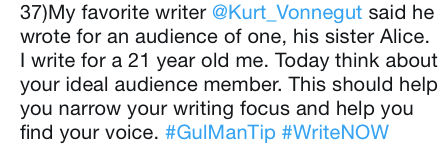

Here’s to appreciating our John McAleers . Here’s to writing for one person. Here’s to knowing who that one person is. Mine is my mom or 22-year-old me.
3. The fourth verse from Walt Whitman’s “I Sing The Body Electric” :
I have perceiv’d that to be with those I like is enough,
To stop in company with the rest at evening is enough,
To be surrounded by beautiful, curious, breathing, laughing flesh is enough,
To pass among them or touch any one, or rest my arm ever so lightly round his or her neck for a moment, what is this then?
I do not ask any more delight, I swim in it as in a sea.
There is something in staying close to men and women and looking on them, and in the contact and odor of them, that pleases the soul well,
All things please the soul, but these please the soul well.
2. Sara Bareilles.
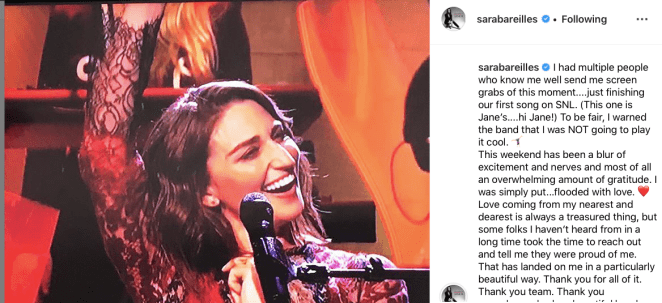
I’m not a religious person. I grew up going to a Unitarian Universalist church in Lexington, Massachusetts, which is the parochial equivalent of seeing the same Grateful Dead cover band perform every Sunday morning with the occasional Mary Oliver reading. In my 20s, I’ve always found quiet spirituality in solitude without ever needing a formal service or building. And yet—and yet!—watching this, listening to this, roughly once a day every day for the last month, has felt like an ongoing religious experience. Religious experience in the sense of feeling an out-of-body connection and belonging. To something big and enduring and forgiving and miraculous and Sara Bareilles-written and performed.
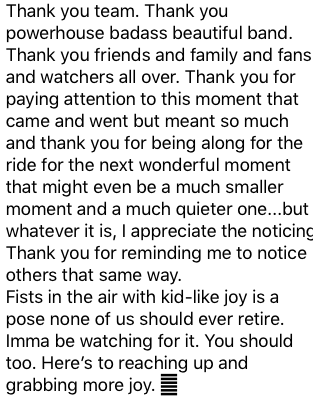
Aside from making beautiful ballads and cheeky pop anthems, she’s a kind hero, a goofy hero,
and a hero in gratitude and thoughtful reflection:
1. “Keep Going”—Austin Kleon. Austin Kleon’s first book in his Crea-Trilogy, “Steal Like An Artist,” came out in 2012, and it changed my life. I don’t use the expression “changed my life” lightly—or ever, really— because it feels like empty language and a reductive way of describing a vital thing with impossibly wide ripple effects. But “Steal Like An Artist,” when I read it my senior year of college, changed. My. Life. It was like someone was giving me permission to do what I already felt—but had felt tentative to actually do. Be Boring (It’s The Only Way To Get Work Done.). Write The Book You Want To Read. Don’t Wait Until You Know Who You Are To Get Started. (Not to mention, his books are so fun to hold and look at).
Since then, Kleon’s come out with two more Self-Help Creativity books. He writes. He draws. He does blackout poetry. He collects quotes—that, in volume and quality and interconnectedness, are something else. He includes pictures of his 6-year-old son rocking out on the keyboard. He’s an epic curator. His writing is somehow both a triple-shot of inspiration and a calming balm for the restless soul. His work is the Sistine Chapel of communicating big, messy ideas cleanly, clearly, and unpretentiously.
Selfishly, his books feel like they’re manufactured in a lab just for me. “Steal Like An Artist,” for me, was a gentle push out of the nest. “Show Your Work” was a flying companion. And now, “Keep Going” feels like a fully-formed Flying V.
 Child's Play
Beautiful. Keep going.
LikeLiked by 1 person
❤
LikeLike